
Addressing the Brazil-Russia-India-China Summit in Brasilia, he said the four countries can benefit by sharing their experiences in the field of inclusive growth.
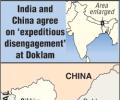
'While overall this is a face saving deal just before the BRICS meeting in Xiamen, any forward military movement at Doklam once again could bring the two Asian giants at loggerheads,' says China expert Srikanth Kondapalli.

Prime Minister Manmohan Singh left Washington on Wednesday for Brazil after attending the Nuclear Security Summit and holding talks with US President Barack Obama during which he asked him to press Pakistan to rein in Lashkar-e-Tayiba and other terror outfits targeting India.On the second leg of his 8-day two-nation tour, Singh headed to Brasilia where he would attend the India-Brazil- South Africa and the Brazil-Russia-India-China summits on Thursday and on Friday.
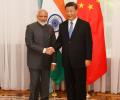
'The fact that Modi and Xi exuded confidence to accelerate the negotiations for a border settlement alone underscores that the Russia-India-China triangle has become very dynamic,' notes Ambassador M K Bhadrakumar.

Top Indian and Chinese officials on Tuesday finalised President Xi Jinping's maiden visit to India, including the programme and key issues to be discussed, amid indications that he may begin his tour in Prime Minister Narendra Modi's home state of Gujarat on September 16.

It is the first meeting between the two leaders after India boycotted the high-profile Belt and Road Forum.

Raking up the border issue, Congress leader Rahul Gandhi on Friday said every individual in Ladakh knows that China has "taken away our land" and claimed that Prime Minister Narendra Modi's assertion that not an inch of land was taken away was "absolutely false".

'I was a bit startled when our host spoke with such force and at such great length about Terrorism.' 'Where did that come from?' 'He kept insisting that it comes from across the border.' 'I could not remember who all are across India's borders and was looking puzzled, but Zuma who understood my predicament, whispered "Pakistan".'

Finance Minister Nirmala Sitharman on Friday met her counterparts in Singapore and Canada and discussed various issues, including economy, health and opportunities for collaboration. Sitharaman met UK Chancellor of the Exchequer Rishi Sunak, Singapore Finance Minister Lawrence Wong and Canada's Deputy Prime Minister & Finance Minister Chrystia Freeland on the sidelines of the G-20 Joint Finance and Health Ministers' meeting. "Finance Minister Smt. @nsitharaman had an engaging discussion with @cafreeland Dy. Prime Minister & Finance Minister of Canada on the sidelines of #G20 Finance & Health Ministers Meeting in #Rome. The Ministers discussed various issues, including economic and health cooperation," a Finance Ministry tweet said.

'Breaking out of the corner into which China has painted itself would be a feat.' 'Whether Xi is able to pull it off will be known in the coming days,' says B S Raghavan, the distinguished civil servant and member of the Joint Intelligence Committee at the time of China's invasion of India.

Prime Minister Narendra Modi on Wednesday thanked President Vladimir Putin for Russia's help and support in India's fight against Covid-19 as the two leaders agreed to establish a "2+2 ministerial dialogue" between foreign and defence ministers to add further momentum to the bilateral strategic partnership.

President Pranab's four-day visit to China that saw him meeting the top Chinese leadership and discussing the sticky boundary issue and cooperation in combating terrorism besides the need for a predictable nuclear regime.

The regulatory changes brought in by the insurance regulator and the amendments proposed to the Insurance Act by the Centre may herald a new dawn for the sector in India. This may result in insurers bringing out more consumer-led products, top honchos of general insurance companies of the country concurred at the Business Standard BFSI Insight Summit 2022.
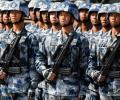
'The possibility of another incursion, a probing manoeuvre in areas where Indian defences are vulnerable cannot be ruled out.'

Prime Minister Narendra Modi on Monday left for home after wrapping up his eight-day whirlwind tour of five Central Asian countries and Russia during which ties with these nations were strengthened and India was accepted as a full member of the SCO.

'If an 'informal meeting' with Xi Jinping materialises before the SCO summit in June, that itself could be regarded as a significant breakthrough in India-China relations,' says Ambassador M K Bhadrakumar.
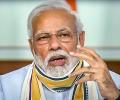
This is more than 25 per cent higher as compared to the same period of the previous year when the prime minister had 78 domestic engagements.

This will be Prime Minister Modi's sixth G20 Summit which is being held at Osaka on June 28-29.
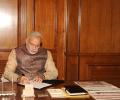
In the first secretary-level appointments by the Narendra Modi government, Rakesh Garg was on Sunday named the new telecom secretary while Jugal Kishore Mohapatra is to be secretary in the fertilizers ministry.
India said that "a range of issues" were discussed by the two leaders.

Echoing the position articulated by Prime Minister Manmohan Singh, China and Russia on Thursday warned that imminent withdrawal of fiscal stimulus by the US could have an adverse impact on the global economy and cautioned the Obama administration against it.

He also offered India's experiences of participative political institutions, local governance, media and civil society with Africa.

'From the very start, PM Modi was insistent that visiting foreign leaders should be exposed to an India beyond its capital.' 'Through these experiences, he felt that the full Indian narrative would be much better understood across the world,' explains External Affairs Minister S Jaishankar. A riveting excerpt from Bluekraft Digital Foundation's Modi@20: Dreams Meet Delivery.

In what is seen as the first sign of China's exasperation over Russia's Ukraine war, Chinese President Xi Jinping on Thursday raised 'questions and concerns' over the conflict in his meeting in Samarkand with Russian President Vladimir Putin who thanked Beijing for its 'balanced position' on the crisis.
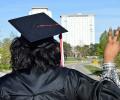
Barring a few, most of the B-schools end up as mere fillers for aspiring students, says Ramesh Kailasam. India needs to have more focused B-schools which are qualitative and practical oriented to churn out students ready to take on the challenge to steer India Inc. and the nation forward.

Prime Minister Narendra Modi leaves for Brazil on Sunday for attending the five-nation summit of BRICS nations on July 14 and 15 which is expected to finalise the setting up of a development bank and seek reforms of the United Nations and international financial organisations.

The new rail and road cargo service launched on Friday, linking Guangdong, Tibet and Nepal, aims to boost trade with the South Asian neighbour as China pushes forward its Belt and Road (Silk Road) initiative, state-run Xinhua news agency reported on Saturday.

Delhi held out "veiled threats' to China over visa issue.

Terrorism can be contained only with strong public support, Prime Minister Narendra Modi has said while appreciating the "template" set by the Bangladesh government in this regard after the terror attack in Dhaka in July.

Yielding to opposition demand, the government on Thursday agreed for a discussion in the Rajya Sabha on Gaza situation on Monday but not before proceedings of the day were washed out over the issue.
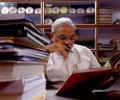
Narendra Modi, who used to tweet frequently, is said to have decided to maintain a single voice on Twitter after becoming prime minister. Nivedita Mookerji reports

'China has reclaimed, after two years, its mantle as the world's fastest-growing large economy.' 'This, when its working age population is shrinking, while ours is growing.' 'And talking of jobs, China expects to create 11 million urban jobs this year; for India, don't ask,' says T N Ninan.

Former Union minister Suresh Prabhu would be India's Sherpa at the 14th meeting of the world's top economies in Osaka, Japan.
The Prime Minister's statement before leaving for Russia.

Chinese President Xi Jinping has suggested five thrust areas to improve relations with India. It is likely all these issues, in addition to the points raised by Xi at Fortaleza, will be part of the joint declaration at the end of his visit to India, says Srikanth Kondapalli.

It has been obvious that the Sino-Pak axis would conspire to weaken India's sovereignty in Jammu and Kashmir, if not wrest Kashmir, says David Devadas.

Wang arrived in Delhi on Thursday evening in the highest-level visit between the two countries after the ties came under severe strain following the military standoff in eastern Ladakh that began nearly two years ago.
Apart from emphasising the importance of India's economic development, and its re-integration into the global economy, Dr Singh has repeatedly emphasised the importance of the ideas that define the Indian civilization and the Indian Republic for global peace, security and challenges, ranging from terrorism to pandemics.
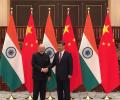
Modi said both India and China need to be "sensitive" to each other's strategic interests and called for specific actions to "prevent growth of negative perception".

Modi held several bilateral and trilateral meetings with world leaders.
